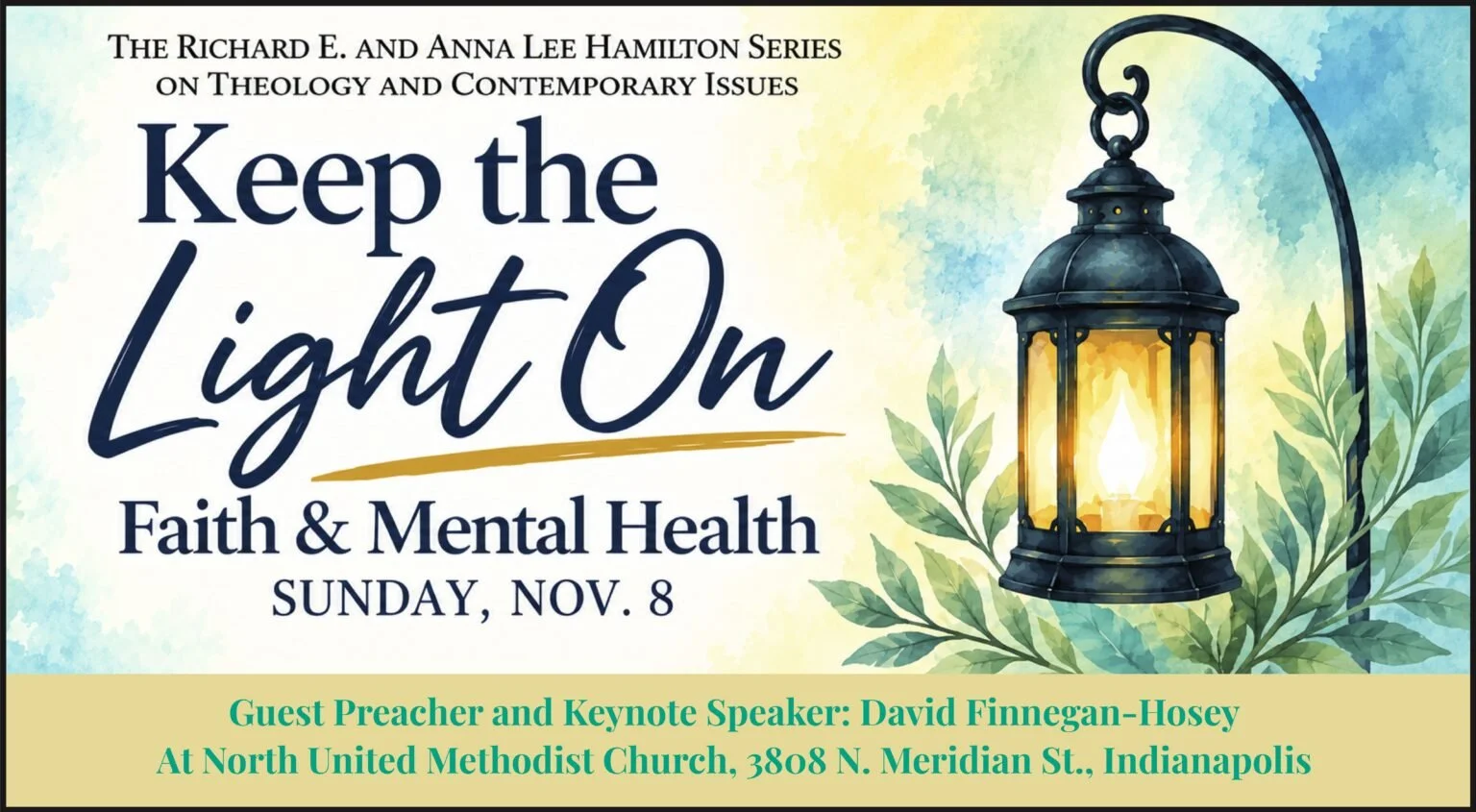
“Midnight Oil and the Empty, Anxious Market”
Sermon by Rev. David Finnegan-Hosey for
North Church Indy’s – Hamilton Lecture Series
November 8, 2026
Based on Matthew 25:1-13
Reading this strange parable has me thinking about oil sellers.
I’ve never been a bridesmaid, but for a while I worked for a non-profit that, as a fundraiser, sold fair trade Palestinian olive oil. So in a way, I guess I’ve been an oil salesman – olive oil, not snake oil, just to be clear. Nor, of course, the kind of oil sales that have been popping up in the news far too often recently – I for one look forward to a day when I can go to a coffee shop without hearing the Strait of Hormuz mentioned. No, I mean I’ve been thinking about the oil sellers in this strange, uncomfortable text, the oil dealers that the quote-unquote ‘wise’ bridesmaids tell the quote-unquote ‘foolish’ bridesmaids to go visit when they both wake up at midnight, as if we are to believe that ancient Palestine had a 24-hour oil market, like a gas station convenience store for lamp fuel.
And I’ve been thinking about the extent to which, in this day and age, so many of us are expected – expected perhaps by others, or perhaps by our own self-imposed pressure – to be open at midnight, so to speak, to be constantly available and with oil to provide to anyone who might come our way. Reachable by email or cell at any hour, with constant access to news, polls, market data, personal updates from friends or family for us to compare ourselves against.
And for those of us who are Christian, or who see ourselves with some obligation to live lives of compassion and spirit and care, it’s even tougher than that, isn’t it? How do we keep the lights on, how do we keep the lamps lit, when all around are the signs that there isn’t enough to go around?
Not to mention, for those of us in the church, there’s a lot of anxiety about oil sales these days! There’s concerns that we’re sitting too comfortably in our own market place, not being creative enough with new ways to get oil to people we just know should have it, not doing enough to attract new customers or seek out alternative sales venues. Anxiety – again, whether imposed by others or by ourselves – is high.
We are not only supposed to burn the midnight oil but also to have oil to spare at midnight.
If this whole marketplace analogy is uncomfortable for you, let me just say that it is to me as well – in fact, this whole story at the beginning of the 25th chapter of Matthew’s gospel is uncomfortable for me. I don’t like it. I don’t like its binary between the ‘foolish’ and the ‘wise,’ as if we’re all one or the other. I don’t like its seemingly merciless bridegroom who, I think we are to assume, represents Christ – wouldn’t Jesus want us to share our lantern oil, to shine our lamplight for others? And of course, there’s the problem of those supposed late night oil dealers.
The whole analogy – scholars debate whether this is a parable or an analogy, but we’ve got a long way to go today so I won’t get into it – the whole analogy makes me uncomfortable which, in turn, makes me ponder whether my own imagination and understanding of spirituality needs some tinkering, yet again.
Perhaps we are not called to be oil sellers at all.
Maybe instead we should take a nap.
Really – one of the most fascinating pieces of this odd little story is that both the ‘wise’ and the ‘foolish’ bridesmaids fall asleep. So the difference isn’t that some sleep and others stay awake. Jesus may end this parable by saying “keep awake” – but that’s exactly what the bridesmaids don’t do, the wise as much as the foolish. In fact, the late great Disciples of Christ biblical scholar M. Eugene Boring – I promise he’s a fascinating guy, it’s not his fault that’s his last name – points out that the phrase translated here as “keep awake” can, in Matthew’s gospel, just as easily mean “be prepared.”
“Keeping awake,” Boring writes, “in the sense of constantly being on the alert for signs of the coming of the Son of Man, is not Matthew’s understanding of responsible discipleship. Matthew opposes the frantic quest for [end-times] information, and he pictures faithful disciples as those who do their duty at appropriate times and are thus prepared for the [return] whenever it comes. Such disciples can lay down to sleep in this confidence, rather than being kept awake by panicky last-minute anxiety.”
It’s the anxiety that’s the issue here, not the napping. Because again, the difference is not so much in the oil as it is in the anxiety provoked by the oil levels. The bridegroom had been delayed, but actually shows up right away, almost as soon as the quote-unquote foolish bridesmaids have left. The little bit of oil might have lasted just fine. One wonders what might have happened had the bridesmaids all stayed, instead of running off at the suggestion from the quote-unquote wise ones (who are maybe being a bit snarky, or are just grumpy after waking from their nap, or maybe had bought into a certain scarcity mindset that insists there isn’t enough oil for everyone) that the quote-unquote foolish ones seek out the probably nonexistent midnight oil dealers.
Maybe what we’re called to is to help model the sort of non-anxious presence by which we could take a nap, literally even as Christ returns, and wake up thinking, “You know, that was a good choice.”
This matters to me. As someone with a diagnosed mental illness, I have learned two things that are simultaneously true. First, sometimes I’m not in charge of how much oil I have in my reserves. Sometimes bipolar disorder messes with that. That’s not my fault or anyone’s fault – it’s just part of what it means to live life as David Finnegan-Hosey.
And second, there are still things I need to do – take my medication, talk to my therapist, practice mindfulness, have a strong emotional support system – to keep my reserves as stocked as possible. Practices like centering prayer, praying with scripture, reading the Psalms – these are all good in themselves, right? They’re faithful practices – and they also help me be aware of my oil levels so that I’m not caught off guard. They help turn down the volume of that voice of anxiety and scarcity that would likely have me running off toward the market, looking for something, anything to give me a temporary dose of dopamine relief, rather than taking a deep breath and turning my face towards Christ.
And too, it bears remembering that this strange story begins the 25th chapter of Matthew’s gospel, which will then conclude with a much more familiar (to most of us) story about sheep and goats, those who fed the hungry, quenched the thirsty, welcomed the stranger, clothed the naked, cared for the sick, visited the prisoner – and those who didn’t. The chapter may begin with an image of the Bridegroom as oddly rigid, unwelcoming, severe – but it ends with “Just as you did it to the least of these, you did it to me.” What it means to be prepared for Jesus is to engage in the kind of discipleship, acts of mercy and grace, that are outlined in Jesus’ mountaintop sermon in Matthew and emphasized in the concluding parable of his final discourse.
And what I always point out to my own congregation about that more well-known parable is that it’s a story about two groups who were surprised that Jesus had been there all along. One group surprised that they had been caring for Christ whenever they cared for their neighbor; another group surprised that they had been neglecting that same Christ. But the Church is the fellowship of people who are not supposed to be surprised by this revelation! We’re supposed to know that we see Christ in our neighbors – that Jesus is, for the Ted Lasso fans out there, like Roy Kent – he’s here, he’s there, he’s every….well, anyway.
And we come together every week both to share the ways we’ve seen Christ and also to confess the ways we’ve fallen short in doing what we’re called to do. We ask for forgiveness. We ask for God to change our hearts and our minds, to fill us with the Spirit and grace as we go out again and try it again next week, when we will fall short once again – but that’s what grace is all about, isn’t it? It doesn’t have to be perfect. And rest is as much a part of the call as anything else.
The great Howard Thurman calls this “the principle of alternation”: “Carry the burden, actually, and then put it down,” he says. “Carry one’s vicarious load by seeking to redeem and to heal, and then let it go.”
Do the work, in other words – of caring for others and yourself. Really do it. And then for goodness sakes, take a nap.
Keep the lanterns lit – keep the light on. But remember that in a shadowed valley, a little bit of light goes a long way.
In her poem, “I measure every Grief I meet,” Emily Dickinson imagines comparing the weight and size of her griefs and pains with others she observes. “I wonder,” she writes, as she looks out over an imagined crowd of faces, “if it hurts to live – and if They have to try – and whether, could They choose between – it would not be – to die.” The very real pain of depression and even of suicidal ideation clouding about her words, she goes on: “I note that Some – gone patient long – at length renew their smile – An imitation of a Light that has so little Oil.”
A little oil, it turns out, goes a long way. As Dickinson concludes her poem, the solidarity she feels in noticing that she is not alone in her pain, that others have grief like hers, is pictured ultimately as “passing Calvary,” a carrying of the cross – a yoke, it turns out, that Jesus always intended to be shared.
Christ is the one who knows our pain. Who takes it on, as we note in passing Calvary. Who, in the word of the Epistle to the Hebrews, sustains us and bears along with us. The real Bridegroom, it turns out, does not, in the main, say “I do not know you,” but rather is the one who knows us most deeply. And it is that Bridegroom who calls us into a non-anxious restfulness so that that we can hear the call to enter the heavenly banquet, where at the last there is room for us all – if only we would run towards it; run towards Christ; rather than away from it toward an anxious and ultimately empty marketplace.
Amen.